Informational only, not legal or tax advice. Verify with official sources.
Announced Effective
Thailand replaces its broad short-stay exemption
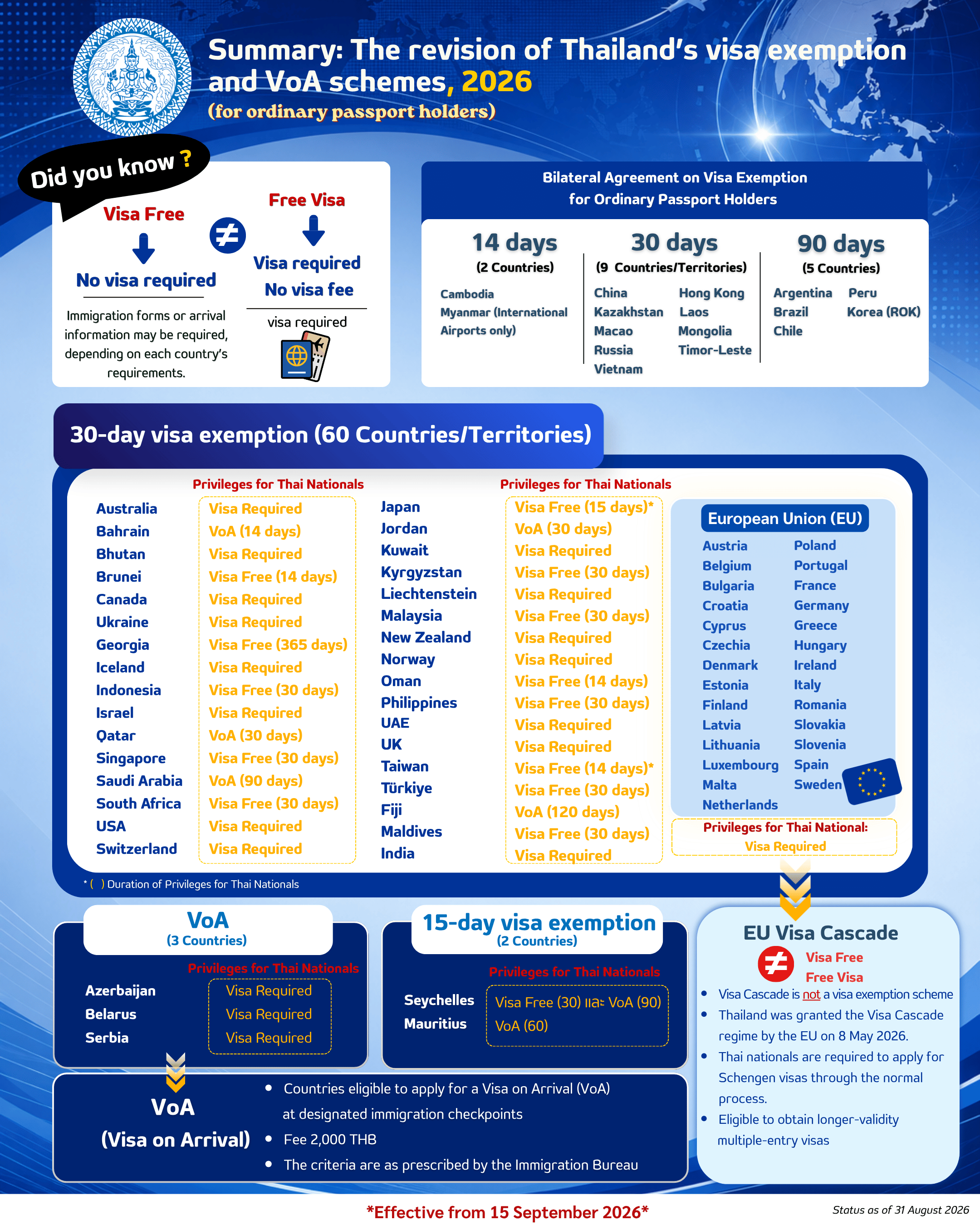
Thailand announced the end of its broad 60-day visa exemption, effective 15 September 2026. Travellers must now check the replacement nationality chart instead of relying on the former general allowance. The chart separates bilateral agreements, unilateral exemptions and visa-on-arrival eligibility; those routes can carry different limits. The change does not shorten permission already granted to someone who entered before the effective date. Other visa categories continue under their own conditions. For a new trip, use the rule for the passport and route being used, then check the stay date granted at entry. A previous visit under the retired scheme does not establish the allowance for a later arrival.
China expands transit and Hainan access for Vietnam and Kyrgyzstan
China added ordinary-passport holders from Vietnam and Kyrgyzstan to its 240-hour visa-free transit programme from 20 August 2026. The transit route requires confirmed onward travel to a third country or region and entry through an eligible port. It should not be presented as an unrestricted tourist waiver for a return trip to the same place. The same announcement also brought those passports into the separate Hainan visa-free scheme, which allows a stay of up to 30 days in the province under its own conditions. The authorities distinguish the allowed visit purposes from employment, study and journalism, which still require the relevant permission. The routes need separate records when rendered.
China extends the Russian ordinary-passport waiver
China announced that its unilateral visa waiver for Russian ordinary-passport holders will continue through 31 December 2027. The scheme permits visits of up to 30 days for the purposes covered by the waiver, including tourism, business and visiting family or friends. It does not establish a general right to live or work in China. The later consular guidance confirms the extended expiry for Russia and explains that the stay count begins on the day after entry. Travellers who need a longer stay must use the appropriate visa or seek the relevant stay permission when the official conditions allow it. This expiry differs from the date for other temporary unilateral waivers.
ETIAS remains scheduled for late 2026 without a confirmed launch day
The European Commission’s traveller guidance places the start of ETIAS in the last quarter of 2026 and says that the exact date will be announced separately. That is a scheduled window, not evidence that applications are already open or that the requirement has begun. ETIAS is intended for eligible visa-free travellers, while EES records covered border crossings and has a separate operating history. Check the latest official launch notice before travel. Until then, nationality eligibility and existing visa or residence exemptions must be checked against the official ETIAS information.
The EU confirms full operation of the Entry/Exit System
The European Commission confirmed full operation of the Entry/Exit System on 10 April 2026, following its phased introduction. Covered travellers now have their short-stay border movements registered electronically at the participating external borders. The system records travel-document details and biometric information, along with entry and exit events. Its role is to support border checks and identify stays that exceed the permission available. It does not grant extra days or replace the need for a visa where one is required. Frequent travellers should keep their own dates consistent with the official border record. This announcement updates the earlier rollout story; ETIAS remains a separate travel-authorisation programme with a different start process.
The UK’s published fee table increased the ETA application charge from £16 to £20 from 8 April 2026. The short visit visa for a stay of up to 6 months rose from £127 to £135. These are different products: a traveller who qualifies for an ETA does not buy a visitor visa merely because both charges appear in the table. The fee change does not increase the time someone can remain in the country. The official publication history records the new table being added on 18 March 2026. Older announcements can still show previous charges. Check the effective date on the current fee table.
UK carriers enforce digital travel permission for eligible visitors
The UK announced enforcement of digital travel permission for eligible visitors from 25 February 2026. Carriers must check that passengers have an ETA, an eVisa or other valid travel documentation before boarding. The requirement affects travellers who previously could board using an eligible passport alone; it does not replace a visa for someone who needs one. British and Irish citizens remain outside the ETA requirement. The announcement also covers connecting passengers who pass through UK border control. Travellers with an eVisa need their immigration account linked to current passport details. The ETA fee quoted in the original announcement was later changed, so the current fee should come from the newer fee notice.
China adds British and Canadian passports to its short-visit waiver
China announced visa-free entry for holders of ordinary British and Canadian passports from 17 February 2026 through 31 December 2026. Eligible visits may last up to 30 days and include tourism, business, visiting family or friends, exchanges and transit. The announcement concerns those purposes and ordinary passports; it does not turn an employment or long residence plan into an exempt visit. Current consular guidance explains that the stay count starts on the day after entry. Travellers should retain evidence that matches their visit and use the appropriate visa when the intended purpose or length falls outside the waiver. The end date remains a key item for the news desk to monitor.
The Philippines adds a limited short-visit exemption for Chinese passports
The Philippine Department of Foreign Affairs states that Chinese nationals can use a new visa-free route from 16 January 2026 for tourism or business. The allowance is 14 days and cannot be extended or converted into another admission category. It is limited to entry through Manila Ninoy Aquino International Airport or Mactan-Cebu International Airport. Travellers must carry the required valid passport, confirmed accommodation and a return or onward ticket, and remain subject to immigration screening. This route should be shown with its airport restriction rather than as an unrestricted nationwide entry option. Other documents or older conditional transit privileges need their own checks and should not be merged into this allowance.
South Korea keeps the existing temporary K-ETA exemptions for another year
South Korea’s Ministry of Justice extended the existing temporary K-ETA exemption through 31 December 2026, Korean Standard Time. The extension starts on 1 January 2026 and applies to the countries and regions already covered by the temporary exemption. The notice does not create a universal waiver for every nationality. It also does not change the nationality-specific period of stay. An eligible traveller may still choose to obtain K-ETA to use the associated arrival-card benefit, with the normal application charge applying. Existing approvals remain usable until their own expiry. The news desk should verify the separate nationality list before showing an exemption badge on any passport page.
Slovenia opens a residence route for remote workers abroad
Slovenia introduced a temporary residence permit for digital nomads from 21 November 2025. The route covers qualifying nationals outside the EU and EEA who work remotely for an entity abroad or are self-employed abroad, without entering Slovenia’s labour market. The permit may last up to 1 year and cannot be extended. A new application under this route can be made 6 months after the previous permit expires. Applicants need monthly resources of at least twice the relevant average monthly net salary, using the official calculation. The ministry also allows immediate family reunification. Applications can be made through a Slovenian mission abroad, or at an administrative unit by someone already legally residing in Slovenia.
China announced that the temporary unilateral visa-free policy for France and other participating countries would continue through 31 December 2026. It also added Sweden from 10 November 2025. The announcement directs travellers to consular guidance for the exact nationality coverage and conditions. The current guidance sets a 30-day allowance for covered ordinary passports and names the permitted visit purposes. It also makes clear that other travel documents do not automatically receive the same treatment. This item records the extension announcement and Sweden’s start date. Later additions, including the British and Canadian waiver, are separate changes and should not be read back into the original announcement.
Schengen borders begin the phased Entry/Exit System rollout
The European Commission reported that the Entry/Exit System began operating on 12 October 2025. The initial phase allowed participating countries to introduce it progressively at external border crossings. For covered short-stay travellers, the system records passport information, biometric data and entry or exit details electronically. The rollout announcement set 10 April 2026 as the date for full operation, replacing routine passport stamping for the travellers covered by the system. EES is a border-record system, not a new visa or an extra allowance of travel days. Existing short-stay rules continue to determine how much time a visitor can spend in the shared area. A later news item records completion of the rollout.